Statistics Seminar Series: Conditional Formulation of Gaussian Systems on Spatial Networks with Irregularly Distributed Points
Fri, Oct 16 · 2:00 PM Duques Hall · Foggy Bottom
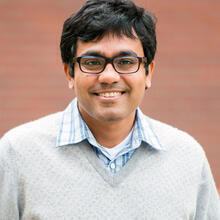
Room 151. Conditional Formulation of Gaussian Systems on Spatial Networks with Irregularly Distributed Points Join the Department of Statistics for a seminar featuring Debashis Mondal, associate professor in the Department of Statistics and Data Science at Washington University in St. Louis. Abstract: In this talk I develop a mathematical and statistical framework for analyzing spatial systems on irregularly distributed point locations. Using conditional formulations, this framework constructs Gaussian systems on spatial networks with symmetric weights for both stationary and non-stationary point processes. The framework associates these systems with reversible Markov chains and, through Kipnis--Varadhan invariance principles, establishes geostatistical scaling limits that recover the de Wijs process or Gaussian free field under stationary sampling and generalize to more complex limits under inhomogeneous sampling. The framework further studies convergence through Beurling--Deny decomposition, the effects of non-uniform sampling on limiting fields, and normalization procedures based on Hungarian embeddings, Sinkhorn normalization, and density correction for restoring canonical limits. It also enables scalable matrix-free computation, REML estimation, conditional simulation, spatial prediction, and sampling-invariant inference on large irregular spatial networks, for which there is currently little parallel in the geostatistical literature. The talk concludes with applications to mapping soil organic carbon in Tanzania, reconstructing global seawater oxygen isotope fields, and analyzing leukemia survival data from northwest England. This seminar presents joint work with postdoctoral scholar Subhrajyoty Roy. About the Speaker: Debashis Mondal is an associate professor in the Department of Statistics and Data Science at Washington University in St. Louis. Previously, he was a faculty member at Oregon State University and the University of Chicago. He earned his Ph.D. in Statistics from the University of Washington. His research spans spatial statistics, computational science, and machine learning, with applications in agronomy, ecology, biodiversity, environmental and climate sciences, sports analytics, crime and police response, and digital humanities. He has received the NSF CAREER Award and the Young Researcher and a Service Awards from the International Indian Statistical Association and is an elected member of the International Statistical Institute.